
AI Industry and Policy Developments, Including Disinformation Risks and Military Drone Swarms

Multiple reports highlighted rapid expansion and adoption of AI across infrastructure, media, and defense, alongside growing governance and societal concerns. Applied Digital said it broke ground on a 430 MW AI-focused data center in the southern US but is withholding the exact location until it can manage local backlash and communications, reflecting broader public scrutiny over data centers’ power demand and electricity-price impacts. Separately, Alibaba was reported to be planning an IPO of its chip unit T-Head to raise capital for large AI infrastructure ambitions and to compete in China’s domestic AI accelerator market, while Japan’s Toto drew investor attention for its semiconductor supply-chain business (electrostatic chucks used in NAND manufacturing) benefiting from AI-driven memory demand.
On the risk side, academic research warned that combining LLMs with multi-agent systems could enable “malicious AI swarms” of persistent, coordinated personas that manufacture synthetic consensus, infiltrate communities, and contaminate future AI training data—shifting influence operations beyond obvious botnets. In parallel, China’s PLA showcased a 200-drone swarm concept reportedly controllable by a single operator and designed to continue operating under jamming or lost communications via autonomous coordination algorithms, underscoring how AI-enabled swarming is advancing in military contexts. Policy debate also intensified in Canada, where Citizen Lab commentary criticized the transparency and process around a government “national sprint” on AI, arguing for stronger privacy-law modernization and greater accountability from AI companies.
Timeline
Jan 24, 2026
PLA showcases 200-drone autonomous swarm on CCTV
China's military demonstrated a system on state television that it said allows a single operator to control more than 200 fixed-wing drones that can coordinate autonomously and resist jamming.
Jan 24, 2026
Applied Digital starts building undisclosed 430 MW AI data center
Applied Digital began construction of a 430 MW AI data center in the Southern United States while withholding the exact location to avoid overwhelming the host community with publicity.
Jan 23, 2026
Researchers propose defenses against malicious AI influence swarms
The same research called for countermeasures including coordinated-behavior detection, stronger content provenance, privacy-preserving verification, and a distributed AI Influence Observatory.
Jan 23, 2026
Researchers warn AI swarms can manufacture synthetic consensus
An international team published a Science article describing how coordinated AI personas could create the illusion of broad public agreement, threatening democratic discourse and contaminating future AI training data.
Jan 23, 2026
Citizen Lab publishes preliminary concerns about Bill C-2 data-sharing powers
Citizen Lab released an initial analysis warning that Canada's proposed Bill C-2, viewed alongside the Second Additional Protocol to the Budapest Convention and the U.S. CLOUD Act, raises constitutional and human-rights risks.
Jan 23, 2026
Citizen Lab declines participation in Canada's AI 'national sprint'
Ron Deibert said he would not take part in Minister Evan Solomon's 30-day AI consultation process, arguing it lacked credibility and calling instead for stronger transparency and privacy-law reforms.
Jan 23, 2026
T-Head signs carrier deal for domestic AI accelerators
Bloomberg-cited reporting said T-Head reached an agreement with China's second-largest wireless carrier to deploy its Pingtouge AI accelerators alongside other domestic chips.
Jan 23, 2026
Alibaba reportedly plans IPO for T-Head
Bloomberg reported that Alibaba is preparing an IPO for its chip unit T-Head to raise capital, give employees partial control, and support broader AI infrastructure ambitions.
Jan 23, 2026
Goldman Sachs upgrades Toto on AI-driven memory demand
Goldman Sachs analysts upgraded Toto from neutral to buy, citing tight memory-industry supply and demand and expected profit growth tied to AI-related semiconductor demand.
Jan 23, 2026
YouTube backs anti-deepfake legislation and likeness protections
In the same 2026 outlook, YouTube said it supports measures such as the NO FAKES Act and is deploying detection tools to help creators identify unauthorized use of their likeness in uploads.
Jan 23, 2026
YouTube outlines 2026 AI expansion for Shorts and creator tools
CEO Neal Mohan's 2026 outlook announced broader AI features, including tools for creators to generate AI versions of themselves for Shorts, AI music tools, and Gemini 3 integration into Playables for no-code game creation.
Dec 1, 2025
China's first 'drone carrier' begins sea trials
China's first amphibious assault ship described as a 'drone carrier' reportedly entered sea trials in late 2025, potentially extending the country's long-range drone launch capability.
Dec 1, 2025
YouTube reports strong use of AI auto-dubbing
YouTube said that in December about six million daily viewers watched AI-dubbed content for more than ten minutes per day, highlighting growing adoption of its auto-dubbing feature.
Mar 1, 2025
Bloomberg data shows Toto chip business exceeds two-fifths of operating income
Bloomberg-compiled figures cited in the reporting indicated that, as of March 2025, Toto's semiconductor component business contributed more than two-fifths of its operating income.
Jan 1, 2025
T-Head releases 2025 AI accelerator lineup
Alibaba's T-Head developed a 2025 generation of AI accelerators that some Chinese media said could compete with Nvidia's H20 for domestic inferencing workloads.
Jan 1, 2024
China unveils improved Swarm II drone-swarm system
An upgraded Swarm II version was shown with higher speed, longer endurance, and support for multiple payloads, indicating continued development of China's autonomous swarm capabilities.
Jan 1, 2021
PLA displays Swarm I drone-swarm system at Zhuhai air show
China's PLA publicly showed the Swarm I land vehicle at the Zhuhai air show, presenting a system designed to launch and coordinate large numbers of drones.
Jan 1, 2018
Alibaba founds chip unit T-Head
Alibaba established its semiconductor arm T-Head, which initially focused on RISC-V CPUs and enterprise SSD integrated circuits before expanding into AI accelerators.
Jan 1, 1988
Toto begins producing electrostatic chucks for chipmaking
Japanese manufacturer Toto started making ceramics-based electrostatic chucks used to hold silicon wafers during semiconductor production. The business later became a significant contributor to the company's operating income.
See the full picture in Mallory
Mallory subscribers get deeper analysis on every story, including:
Who’s affected and how
Deep-dive technical analysis
Actionable next steps for your team
IPs, domains, hashes, and more
Ask questions and take action on every story
Filter by topic, classification, timeframe
Get matching stories delivered automatically
Related Entities
Organizations
Sources
2 more from sources like toms hardware and security online info
Related Stories

AI Adoption and Governance Updates Across Industry and Government
Recent coverage focused on **AI adoption, governance, and societal impacts** rather than a discrete cybersecurity incident. OpenAI CEO **Sam Altman** argued that comparing AI energy use to human cognition is “unfair,” claiming the energy cost of “training a human” (years of living and food consumption plus evolutionary history) should be considered when judging AI efficiency, and separately warned that some companies are engaging in **“AI washing”**—attributing layoffs to AI as a pretext for workforce reductions—while also acknowledging real job displacement is likely to become more noticeable in the next few years. Enterprises and public-sector organizations highlighted practical AI rollouts and associated risk considerations. **Intel** introduced *Ask Intel*, a support assistant built on **Microsoft Copilot Studio**, alongside a shift away from public phone support toward web-based case handling, while noting response accuracy “cannot be guaranteed.” **Microsoft** removed a blog post that had described training LLMs using a Kaggle dataset derived from **pirated Harry Potter ebooks**, amid ongoing legal uncertainty around fair use and potential contributory infringement exposure. Separately, U.S. federal officials emphasized **targeted AI adoption** and expectation management (with the VA reporting hundreds of AI use cases), while other items included a hobbyist AI dashboard project shared on GitHub and a generic startup article on AI-accelerated MVP development—neither of which provided substantive security-relevant disclosures.
2 weeks ago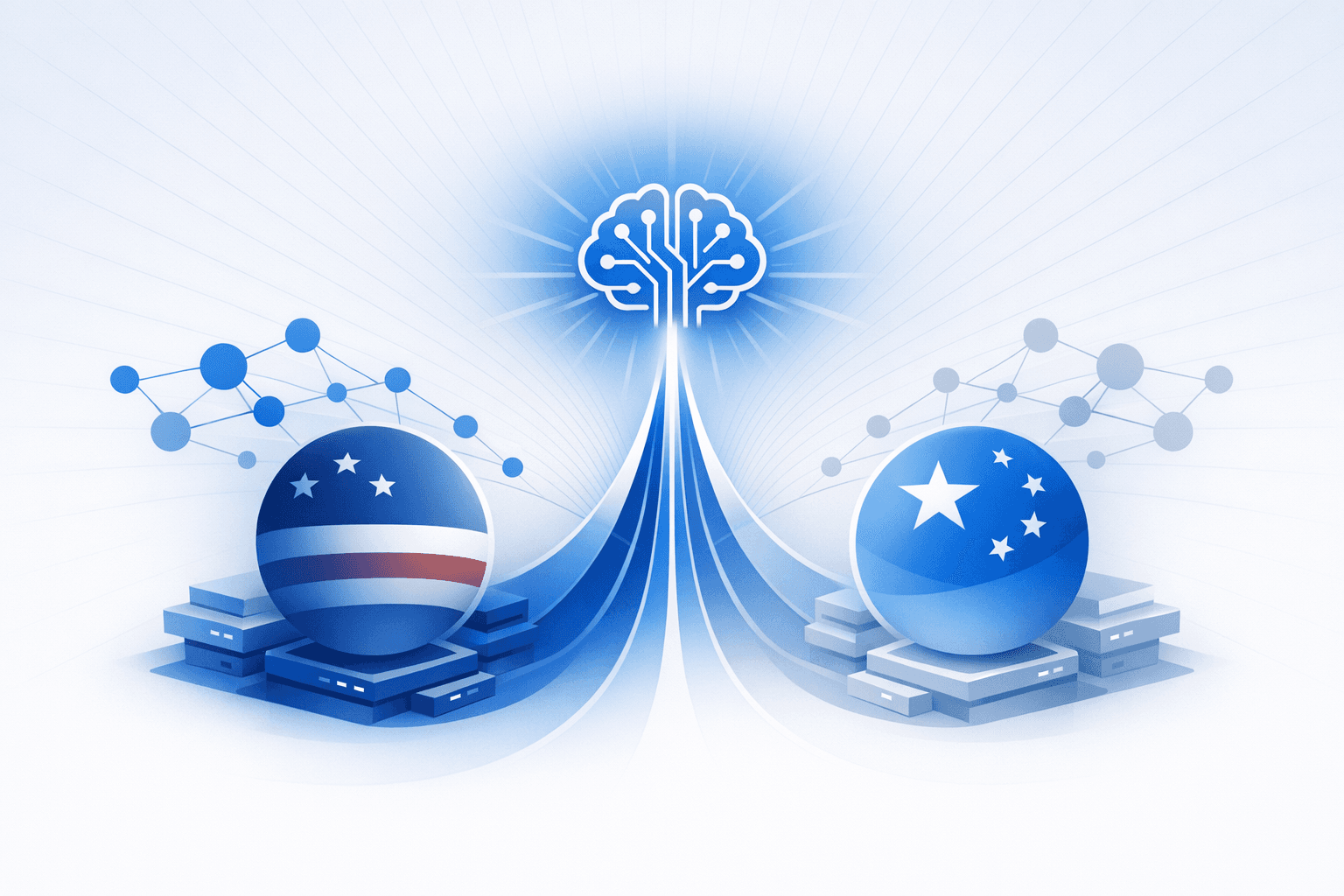
Geopolitical Competition Over AI Compute, Governance, and Global Influence
Reporting and commentary highlighted intensifying **U.S.–China competition in AI** driven less by capital and more by access to advanced compute and the ability to shape global AI governance. In China, a wave of Hong Kong IPOs raising **more than $1B** for domestic AI firms was framed as a confidence signal, but industry leaders warned that funding alone cannot close the gap with leading Western labs; Alibaba *Qwen* leadership reportedly assessed China’s odds of “leapfrogging” **OpenAI** and **Anthropic** via fundamental breakthroughs as **below 20%**, citing structural constraints such as compute availability and ecosystem maturity. Separately, policy analysis argued China is expanding international influence through **AI capacity-building diplomacy**, including a **UN General Assembly resolution** on AI capacity-building (co-sponsored by 140+ countries) and initiatives like training workshops, governance action plans, and infrastructure support aimed at the Global South—while warning the U.S. risks ceding agenda-setting power if it cannot sustain consistent engagement. A third piece captured **Nvidia CEO Jensen Huang** publicly pushing back on “doomer” narratives and the idea of imminent “god AI,” emphasizing current systems’ limits; while not a cybersecurity incident, it reinforces the broader theme that near-term AI outcomes are constrained by practical factors (capability limits and compute), not hype alone.
Yesterday
Policy and industry debate over AI safety, governance, and data protection
U.S. policymakers and industry leaders are escalating scrutiny of **AI safety and data protection**, with a particular focus on sensitive data flows and the adequacy of existing guardrails. In a Senate HELP Committee hearing, lawmakers questioned whether federal guardrails are needed to protect Americans’ healthcare data voluntarily uploaded to AI-enabled apps and wearables that may fall outside HIPAA coverage, raising concerns about liability, downstream data use, and integration into medical records; HHS noted it is collecting public input via a request for information on safe and effective AI deployment in healthcare. Separately, commentary on AI governance and safety argues competitive pressure among frontier AI labs can erode safety practices and that clearer antitrust guidance could enable cross-industry collaboration on safety standards without triggering enforcement risk. Tensions over AI “red lines” in national security use also became more public, as **Anthropic** CEO Dario Amodei accused **OpenAI** of misleading messaging about defense work amid reports that Anthropic’s DoD talks faltered over restrictions related to mass domestic surveillance and autonomous weapons, while OpenAI described its agreement as permitting “all lawful purposes” alongside stated prohibitions. Broader, non-incident reporting highlighted enterprise investment to support *agentic AI* (with many data leaders citing governance lagging AI adoption) and general concerns about deepfakes, opaque models, and societal risk; however, several items in the set were primarily newsletters, vendor/industry promotion, or general-interest AI commentary rather than a single, discrete cybersecurity incident or vulnerability disclosure.
1 months ago