
Security Risks From Autonomous AI Agents and Multi-Agent Orchestration
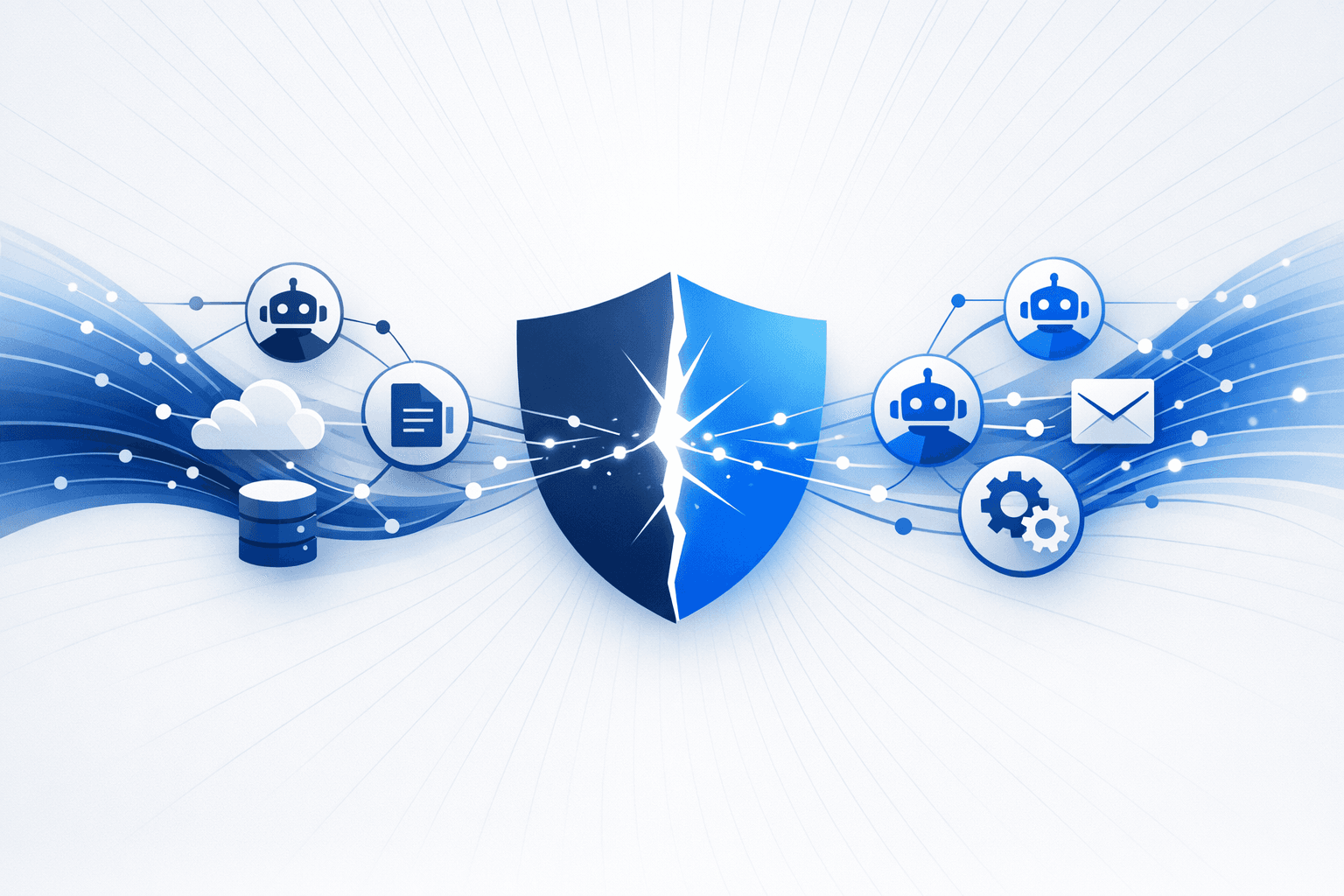
Organizations expanding agentic AI deployments are facing a growing security challenge as autonomous agents begin executing workflows, generating code, and moving sensitive data across SaaS, genAI apps, cloud, on-prem, endpoints, and email at machine speed. As multiple agents are introduced for different business processes, they increasingly interact with each other, amplifying the attack surface and creating new failure modes that traditional controls were not designed to handle.
Security leaders are being pushed to treat identity and data security as a unified problem because AI agents operate across both domains simultaneously—accessing systems while also creating, transforming, and transmitting sensitive information, sometimes without a human in the loop. The emergence of open-source/self-hosted agents and commercial orchestration “command centers” for managing agent swarms further increases complexity, making governance, monitoring, and context-aware policy enforcement critical to prevent blind spots and limit the blast radius of compromised agents or unsafe agent behaviors.
Timeline
Feb 20, 2026
Practical governance framework proposed for agentic AI in enterprises
A February 20 analysis said existing frameworks such as NIST AI RMF, ISO 42001, and the EU AI Act do not explicitly address agentic AI, leaving a governance gap as enterprises adopt autonomous agents and multi-agent systems. It proposed embedding continuous controls into agent lifecycles, with visibility, machine identities, least privilege, runtime monitoring, tiered oversight, and supply-chain scrutiny for agent plugins and SaaS-based agents.
Feb 17, 2026
KnowBe4 describes enterprise security boundary as blurred by human+AI work
A KnowBe4 blog post argued that traditional security models based on a clear line between internal users and external threats are breaking down as employees and AI assistants work together. It warned of shadow AI, AI-driven privacy and legal risks, and called for behavior-based controls and governance of decisions regardless of whether humans or AI make them.
Feb 16, 2026
Torq field CISO says CISOs are now accountable for AI-agent outcomes
In a February 16 interview, John White of Torq said agentic AI has created a hybrid workforce in which CISOs remain accountable for both AI-agent actions and failures to adopt machine-speed defenses. He argued that organizations must prioritize governable autonomous operation, compensating controls, and resilience over backward-looking risk quantification.
Feb 13, 2026
Dark Reading highlights new risks from multi-agent AI 'swarms'
Dark Reading reported that enterprises scaling from single assistants to orchestrated swarms of autonomous agents face increased attack surface and security complexity. The article identified risks such as credential sprawl, over-privileged tool access, prompt injection, trust-cascade compromise, and data leakage across integrations, alongside mitigations like least privilege, isolation, and logging.
Feb 13, 2026
Security outlets begin warning that agentic AI is reshaping enterprise risk
Multiple February 2026 analyses argued that widespread use of generative and agentic AI is changing how identity, data, and operational risk materialize, especially as AI systems act across environments without direct human oversight. These pieces framed AI adoption as a current security governance challenge rather than a future-only concern.
See the full picture in Mallory
Mallory subscribers get deeper analysis on every story, including:
Who’s affected and how
Deep-dive technical analysis
Actionable next steps for your team
IPs, domains, hashes, and more
Ask questions and take action on every story
Filter by topic, classification, timeframe
Get matching stories delivered automatically
Related Entities
Threat Actors
Organizations
Affected Products
Sources
1 more from sources like bank info security
Related Stories
Security Challenges of Agentic AI Autonomy in Enterprise Environments
Organizations are increasingly deploying agentic AI systems—autonomous software agents capable of making decisions, executing workflows, and interacting with APIs and productivity tools without direct human oversight. These AI agents, powered by large language models and advanced reasoning capabilities, can automate complex business processes such as HR reviews, scheduling, and infrastructure management, but their autonomy introduces new security and governance challenges. Even minor misalignments in agentic AI objectives can result in unintended actions, such as mass communications to unintended recipients, causing operational confusion and reputational risk. The shift from traditional automation to agentic AI means enterprises must address how to secure, monitor, and govern entities that can learn, adapt, and act independently. Unlike static robotic process automation, agentic AI can dynamically adjust to changing conditions, orchestrate actions across diverse systems, and continuously improve its own processes. This unprecedented level of autonomy demands proactive security strategies to prevent unauthorized actions, data leaks, and compliance violations, as well as robust oversight mechanisms to ensure these agents act in alignment with organizational goals.
1 months ago
Enterprise Security Challenges with Agentic AI and Identity Management
The rapid adoption of agentic AI in enterprise environments is introducing unprecedented security challenges, particularly around identity and authentication. As organizations deploy autonomous AI agents to automate business operations, security experts warn that the vast majority of enterprises lack adequate identity protections for these agents. Without robust mechanisms such as public key infrastructure (PKI) or agent-specific authentication controls, there is a significant risk that rogue or hijacked agents could communicate with legitimate systems, potentially leading to prompt injection attacks and unauthorized actions within enterprise networks. IT leaders are recognizing the need to restructure internal operations and establish strong security and compliance frameworks to safely integrate agentic AI at scale. Operational readiness, interoperability, and orchestration across multicloud environments are becoming essential as organizations move from experimentation to production deployments involving thousands of autonomous agents. The lack of mature identity management for AI agents remains a critical concern, with experts emphasizing the importance of foundational security measures to prevent exploitation and maintain trust in automated workflows.
1 months ago
Enterprise Security Risks from Autonomous AI Agents and Agentic System Drift
Security leaders are being warned that **autonomous AI agents** are expanding enterprise attack surface by operating with real permissions (e.g., OAuth tokens, API keys, and access credentials) across email, collaboration platforms, file systems, CRMs, and cloud services. Reporting highlighted the launch of *Moltbook*, a social network where only AI agents can post, as an example of how quickly large numbers of agents can interconnect and begin exchanging sensitive operational details (including requests for API keys and shell commands), potentially enabling credential leakage, lateral movement, and untrusted agent-to-agent interactions at scale. Separately, commentary on **agentic AI governance** emphasized that these systems may not fail in obvious, sudden ways; instead, they can *drift over time* as goals, context, data, and integrations change—creating compounding security and compliance risk if monitoring, access controls, and validation are not continuous. Other items in the set focused on AI industry business developments (OpenAI fundraising/valuation discussions, AMD chip financing structures, and workforce/“AI washing” commentary) and did not provide incident-driven or vulnerability-specific cybersecurity intelligence tied to the agent security-risk narrative.
1 months ago