
ScarCruft (APT37) Ruby Jumper Campaign Targets Air-Gapped Systems via Zoho WorkDrive C2 and USB Malware
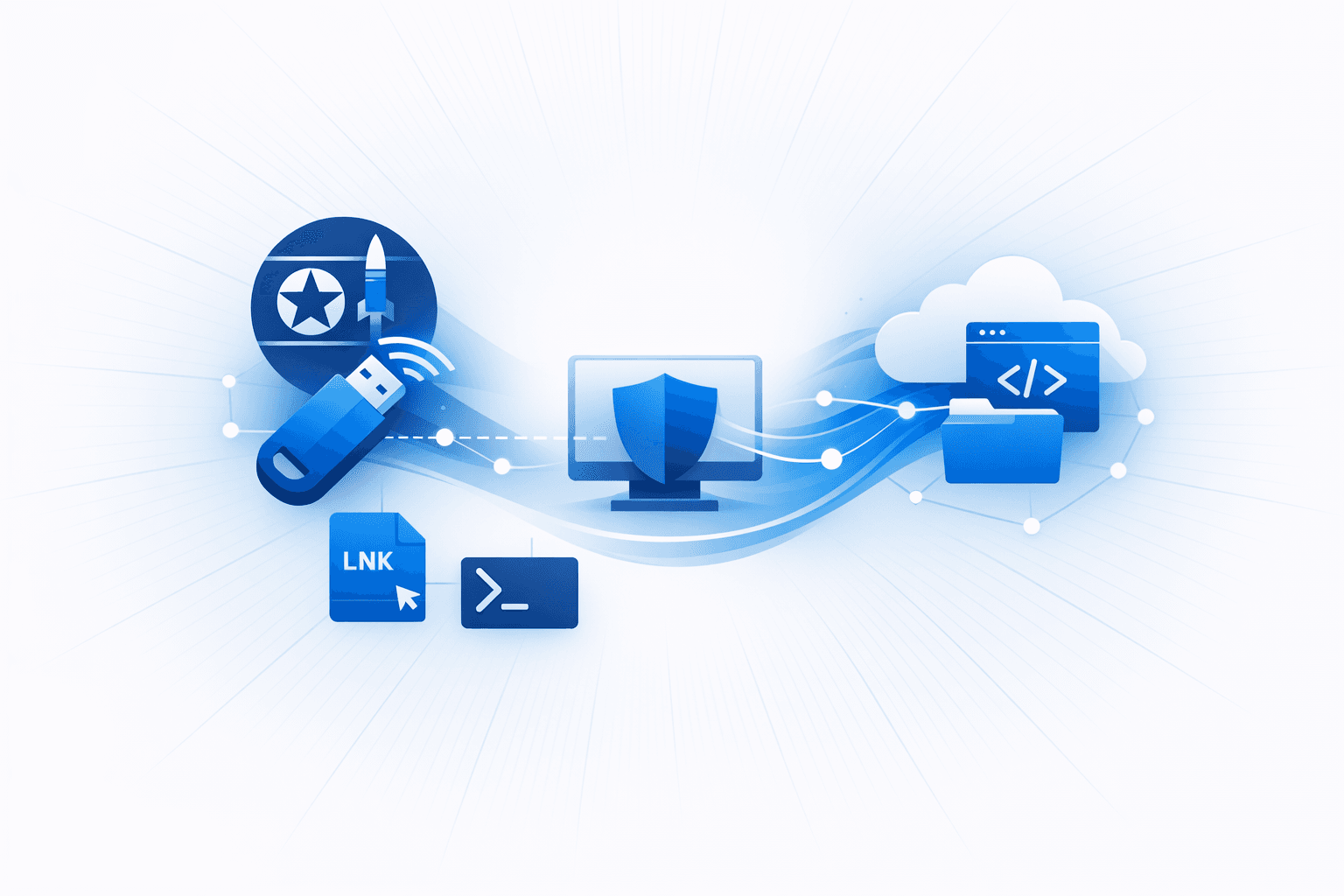
North Korea-linked ScarCruft (APT37) has been attributed to a new espionage campaign dubbed Ruby Jumper that is designed to compromise air-gapped environments using a multi-stage infection chain and removable media. Zscaler ThreatLabz reported the activity was identified in December 2025 and described an initial access method that relies on a malicious Windows shortcut (.LNK); when opened, it triggers PowerShell to extract multiple embedded payloads (including a decoy document and staged scripts/binaries) from fixed offsets within the LNK and then decrypts and executes follow-on code in memory.
The toolset includes multiple malware components—reported as RESTLEAF, SNAKEDROPPER, THUMBSBD, VIRUSTASK, FOOTWINE (and additionally BLUELIGHT in one account)—used to progress execution, establish persistence, and enable surveillance. RESTLEAF was described as using Zoho WorkDrive for command-and-control, authenticating with a valid access token and downloading additional shellcode for execution (including via process injection), representing a noted shift to abusing a cloud storage service for C2; the campaign also includes an implant/workflow that uses removable media (USB) to relay commands and bridge isolated networks, enabling compromise of systems without direct internet connectivity.
Timeline
Feb 27, 2026
Zscaler's findings on Ruby Jumper are publicly reported
Multiple outlets reported on February 27, 2026 that Zscaler had disclosed the Ruby Jumper campaign and its technical details, including attribution to APT37 and the use of cloud services plus removable media to compromise air-gapped networks. The reporting highlighted Zoho WorkDrive abuse as a newly observed ScarCruft command-and-control method.
Dec 1, 2025
Ruby Jumper uses USB malware to bridge internet-connected and air-gapped systems
APT37 used THUMBSBD and VIRUSTASK to weaponize removable media, storing encrypted commands and stolen data in hidden folders such as $RECYCLE.BIN on USB drives. This enabled bidirectional tasking, exfiltration, and propagation between connected hosts and isolated air-gapped machines, with additional surveillance payloads like FOOTWINE available for keylogging and audio/video capture.
Dec 1, 2025
APT37 deploys LNK-based infection chain with cloud-backed malware
In the campaign, victims were lured into opening a malicious Windows LNK file that launched PowerShell, extracted embedded payloads, and displayed an Arabic-language decoy document related to the Palestine-Israel conflict. The malware chain deployed components including RESTLEAF and SNAKEDROPPER, with command-and-control traffic routed through legitimate cloud services such as Zoho WorkDrive, OneDrive, Google Drive, and pCloud.
Dec 1, 2025
Zscaler identifies APT37's 'Ruby Jumper' campaign
Zscaler ThreatLabz discovered a new North Korea-linked campaign in December 2025 and attributed it with high confidence to APT37/ScarCruft. The operation targeted air-gapped Windows environments using a multi-stage malware toolkit and removable media.
See the full picture in Mallory
Mallory subscribers get deeper analysis on every story, including:
Who’s affected and how
Deep-dive technical analysis
Actionable next steps for your team
IPs, domains, hashes, and more
Ask questions and take action on every story
Filter by topic, classification, timeframe
Get matching stories delivered automatically
Related Entities
Threat Actors
Affected Products
Sources
Related Stories

Multiple APT and malware campaigns abusing phishing, cloud services, and signed binaries
Reporting across multiple research teams described a surge of distinct, ongoing intrusion campaigns rather than a single unified incident. **Check Point** reported on **Silver Dragon**, a Chinese-aligned activity cluster assessed as operating under the broader **APT41** umbrella, targeting organizations in **Southeast Asia and Europe** (notably government) via exploitation of public-facing servers and phishing, then deploying **Cobalt Strike**, **DNS tunneling**, and a new Google Drive–based backdoor (**GearDoor**) alongside custom tools (**SSHcmd** and **SliverScreen**) for remote access and screen capture. **Microsoft** detailed separate February 2026 phishing campaigns by an unknown actor that used meeting/invoice-style lures and **EV code-signed** malware (certificate issued to **TrustConnect Software PTY LTD**) masquerading as common workplace apps (e.g., `msteams.exe`, `adobereader.exe`, `zoomworkspace.clientsetup.exe`) to install legitimate **RMM** tooling (**ScreenConnect**, **Tactical RMM**, **Mesh Agent**) for persistent access and lateral movement. Other reporting highlighted additional, unrelated campaigns and tradecraft: **ClearSky** described a Russian-aligned operation targeting **Ukraine** using a phishing-delivered ZIP/HTA chain that drops a .NET loader (**BadPaw**) and backdoor (**MeowMeow**) with **.NET Reactor** obfuscation, parameter-gated execution, and sandbox/tooling checks (with low-confidence linkage to **APT28**). **Cofense**-reported activity (via SC Media) showed phishing that weaponizes **Windows File Explorer + WebDAV** using URL/LNK shortcuts to pull payloads (notably **AsyncRAT**, **XWorm**, **DcRAT**) and infrastructure including **Cloudflare Tunnel** domains hosting WebDAV servers. **Cisco Talos**-reported **Dohdoor** activity (UAT-10027) targeted US **education and healthcare**, using PowerShell→batch→DLL sideloading via legitimate executables (e.g., `Fondue.exe`, `mblctr.exe`, `ScreenClippingHost.exe`) and **DNS-over-HTTPS** to Cloudflare for C2 discovery and tunneling. Separately, **Zscaler** reported **ScarCruft**’s *Ruby Jumper* campaign using **Zoho WorkDrive** for C2 and removable media components to reach air-gapped systems, while another Zscaler report analyzed **Dust Specter** targeting Iraqi government officials with password-protected RAR delivery and modular implants. **Qianxin XLab** assessed sanctioned infrastructure provider **Funnull** resurfacing to support scam/criminal supply chains and potential **MacCMS**-related supply-chain activity, and **F5 Labs** summarized **APT42**’s **TAMECAT** PowerShell backdoor focused on Edge/Chrome credential theft with C2 over Telegram/Discord/HTTPS and specific file/hash indicators. (A separate Help Net Security item on a Microsoft Defender onboarding tool is product/administrative news and not part of the threat-campaign reporting.)
1 months ago
Malware Delivery via Social Engineering: Phishing Lures, Fake Browser Alerts, and Paste-and-Run Payloads
Multiple threat reports describe **social-engineering-driven malware delivery** leading to remote access and follow-on payload deployment. Fortinet observed a **multi-stage phishing campaign targeting users in Russia** that delivers **Amnesia RAT** and ransomware via business-themed decoy documents and a malicious `.lnk` shortcut using a double extension (e.g., `*.txt.lnk`). The infection chain uses public cloud services for staging—**GitHub** for scripts and **Dropbox** for binary payloads—and abuses **defendnot** to trick Windows into believing a third-party AV is installed, effectively disabling **Microsoft Defender** before later-stage execution. Separately, Huntress attributed activity to **KongTuke**, which uses **malicious browser extensions** to display fake “browser crash” security alerts (“**CrashFix**”) that pressure users into running attacker-provided commands, and also deploys a Python RAT dubbed **ModeloRAT**. ModeloRAT is described as heavily obfuscated, using **Windows Registry** persistence and **RC4**-encrypted communications, with the ability to deliver additional payloads (DLLs, executables, scripts). Red Canary’s January intelligence update highlights **Scarlet Goldfinch** activity using **paste-and-run** lures and a notable technique of using the Windows `finger` client to pull remote content (e.g., `finger user@IP | cmd`), followed by `curl` download of an archive masquerading as a PDF and extraction via `tar -xf`, culminating in **Remcos** (and sometimes **NetSupport**) delivered via **DLL sideloading**.
1 months ago
Credential-Theft Malware Campaigns Targeting Windows via Social Engineering and Trusted Services
Multiple reports describe **active malware campaigns targeting Windows users** with a focus on **credential, session, and wallet theft** delivered through social engineering and abuse of legitimate services. **CharlieKirk Grabber**, a Python infostealer packaged with *PyInstaller*, is distributed via phishing, cracked software, cheats, and social-media lures; it kills browser processes (via `TASKKILL`) to access credential stores, collects passwords/cookies/autofill/Wi‑Fi data, zips the loot, uploads it to *GoFile*, and relays the download link to operators via **Discord webhooks** or **Telegram bots**. Separately, attackers are buying **Facebook ads** impersonating Microsoft to drive victims to cloned Windows 11 download pages on lookalike domains (e.g., `ms-25h2-update[.]pro`), delivering a malicious installer that steals saved passwords, browser sessions, and **cryptocurrency wallet** data; the campaign uses **geofencing/sandbox evasion** to show benign content to data-center IPs while serving malware to likely end users. Other contemporaneous activity highlights broader Windows-targeted intrusion tradecraft and adjacent threats. FortiGuard Labs reported **Winos 4.0 (ValleyRat)** phishing campaigns in Taiwan using tax and e-invoice lures, with delivery chains including malicious **LNK** downloaders, **DLL sideloading**, and **BYOVD** using the vulnerable driver `wsftprm.sys`, supported by rapidly rotating domains and cloud hosting. In LATAM, a fake bank-receipt lure delivers **XWorm v5.6** via a `.pdf.js` double-extension WSH dropper that uses junk-padding and Unicode obfuscation, then reconstructs and runs PowerShell (spawned via WMI) and abuses trusted hosting (e.g., Cloudinary) for later stages—enabling credential theft and potential ransomware follow-on. Additional reporting covered a USB-propagating **Monero cryptomining** operation capable of crossing air-gapped environments, a new Linux **SysUpdate** variant with encrypted C2 traffic (and a Unicorn Engine-based decryption approach developed during DFIR), and the **Foxveil** loader abusing **Cloudflare Pages, Netlify, and Discord** to stage shellcode and persist via services or *SysWOW64* masquerading—these are separate threats but reinforce the trend of attackers blending into trusted infrastructure and common user workflows.
1 months ago